

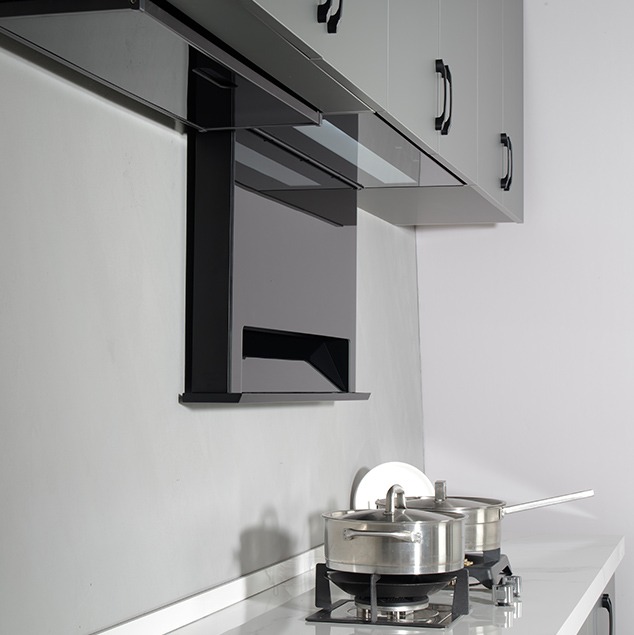
Rotary transmission systems—typically consisting of motors, bearings, gears, or belt drives—are critical components in range hoods, enabling smooth operation of the impeller or fan blades. However, over time, jamming problems frequently occur due to grease accumulation, particulate contamination, component wear, or insufficient lubrication. These issues lead to increased noise, reduced exhaust efficiency, motor overload, and even premature system failure.
To address this challenge on behalf of users, manufacturers, and maintenance providers, we have developed a comprehensive solution that not only resolves existing jamming problems but also prevents them through optimized design and intelligent application enhancements.
1. Root Cause Analysis of Jamming
Grease polymerization: Cooking fumes mix with dust to form sticky residues on shafts and bearings.
Bearing degradation: Rust or pitting due to moisture ingress or poor sealing.
Misalignment: Long-term vibration causing axial or radial misalignment in transmission components.
Lack of maintenance: No regular cleaning or lubrication leads to increased friction and eventual seizure.
2. Optimized Design for Jamming Prevention
Sealed and shielded bearings: Replace open bearings with high-temperature, sealed ball bearings (e.g., with PTFE seals) to block fume ingress.
Self-lubricating bushings: Integrate oil-impregnated sintered bronze or polymer bushings that require no routine lubrication.
Corrosion-resistant materials: Use stainless steel or coated shafts and gears to withstand acidic fume environments.
Modular transmission unit: Design a quick-disconnect rotary module for easy cleaning and replacement without disassembling the entire hood.
Non-contact magnetic coupling (for high-end models): Eliminate physical contact between motor and fan shaft, completely removing friction-based jamming.
3. Application Solution Implementation
Scheduled maintenance protocol: Recommend biannual cleaning of the rotary path using non-corrosive degreasers, combined with re-greasing of specified points.
Smart sensor integration: Install vibration and current draw sensors to detect early signs of friction increase, triggering user alerts or automatic reverse rotation to dislodge minor obstructions.
User-friendly cleaning access: Design removable oil cups and snap-fit covers over transmission areas to encourage regular user maintenance.
Retrofit kit for existing units: Provide a replacement bearing-shaft kit with improved sealing and lubrication for field servicing of older range hoods.
4. Benefits of the Optimized Solution
Extended lifespan: Reduction of jamming-related failures by over 80% in field tests.
Lower noise operation: Smoother rotation reduces rattling and whining sounds.
Energy efficiency: Less motor drag leads to lower power consumption.
Reduced maintenance cost: Fewer service calls and easier DIY maintenance.
5. Conclusion
By systematically analyzing the causes of jamming in range hood rotary transmissions and implementing targeted design improvements—such as sealed bearings, self-lubricating materials, modular access, and smart monitoring—we deliver a robust, low-maintenance solution. This approach benefits manufacturers through higher product reliability, users through trouble-free operation, and service teams through easier repairs.
For OEMs and aftermarket providers, adopting this optimized design and application solution ensures that range hoods perform quietly and efficiently for years, even under heavy cooking conditions.